
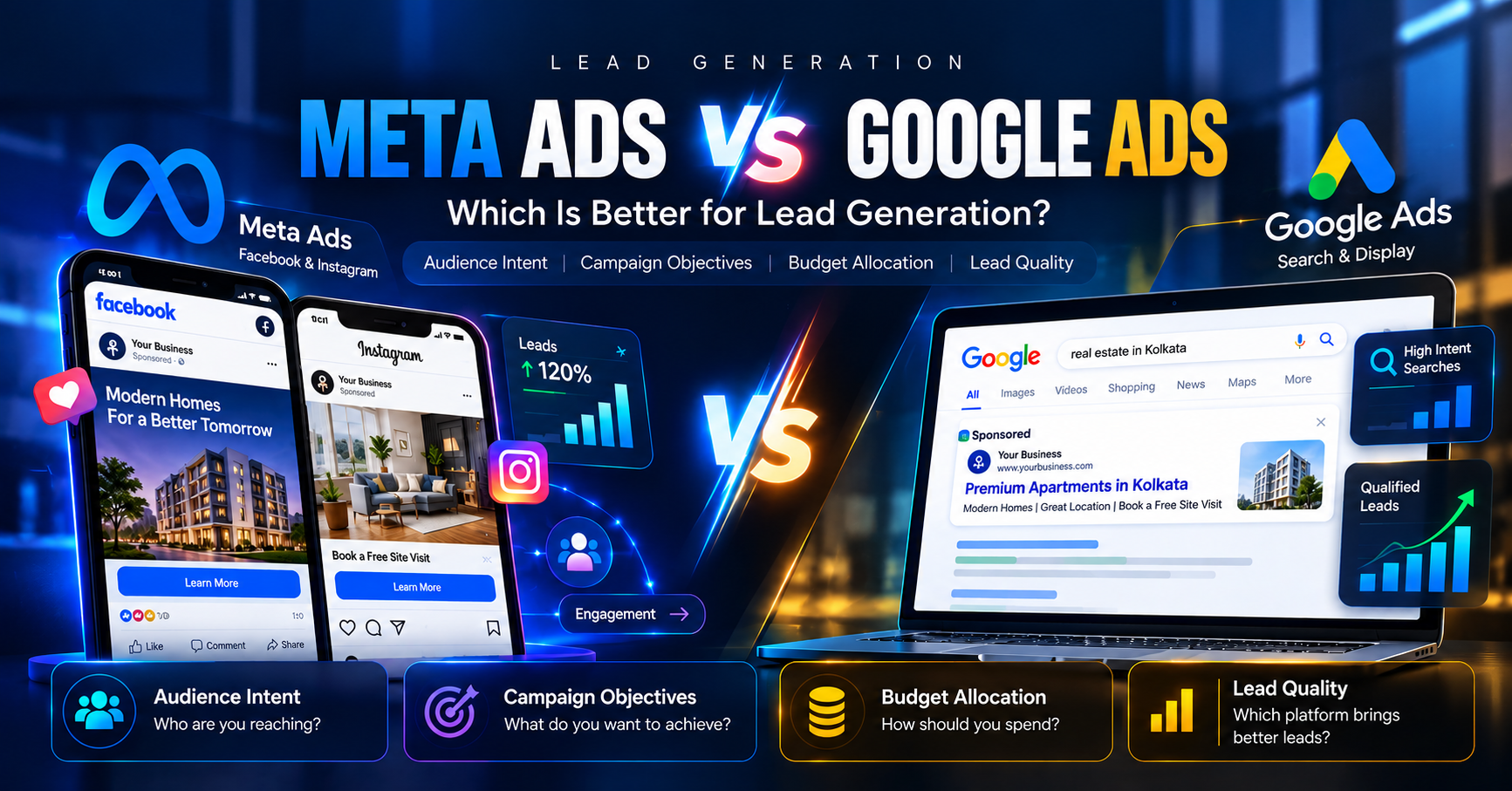
Meta Ads vs Google Ads: Which Is Better for Lead Generation?
Choosing the right advertising platform can make a significant difference to your lead generation results. Businesses investing in digital marketing often face one important question: should they run Meta Ads or Google Ads to attract potential customers?
Both platforms offer powerful advertising solutions, but they work differently. Meta Ads helps businesses reach audiences through Facebook and Instagram, while Google Ads can connect businesses with people actively searching for products or services.
Understanding the difference between Meta Ads vs Google Ads helps businesses make informed decisions about campaign objectives, advertising budgets, lead quality, and customer acquisition.
In this guide, we will compare both platforms and explain how to choose the right approach for your business.
What Are Meta Ads?
Meta Ads is an advertising platform that allows businesses to promote products and services across Facebook, Instagram, Messenger, and other eligible placements.
Businesses can use Meta Ads to reach potential customers based on audience characteristics, interests, behaviours, engagement, and other available targeting signals.
Meta Ads is particularly useful for introducing a business to new audiences, promoting offers, generating enquiries, and reconnecting with people who have previously interacted with a brand.
Key Benefits of Meta Ads
- Audience discovery: Reach potential customers who may be interested in your products or services.
- Visual advertising: Use images, videos, Reels, carousels, and other creative formats.
- Lead generation forms: Collect contact information through forms within supported Meta placements.
- Click-to-message campaigns: Encourage potential customers to start conversations through supported messaging channels.
- Retargeting: Re-engage eligible audiences who have previously interacted with your business.
Meta Ads can be particularly useful when customers need to discover a brand, understand an offer, or see a product before deciding to enquire.
What Are Google Ads?
Google Ads enables businesses to advertise across Google’s advertising network, including Google Search and other eligible placements.
Google Search Ads are especially valuable when potential customers actively search for a product, service, or solution. For example, someone searching for “digital marketing agency in Kolkata” is already expressing interest in finding a relevant service provider.
Google Ads can help businesses appear for relevant searches and guide potential customers towards a website, phone call, enquiry form, or another conversion action.
Key Benefits of Google Ads
- Search intent: Reach people searching for relevant products or services.
- Keyword targeting: Align advertisements with relevant search queries.
- Local lead generation: Target customers searching for services in specific locations.
- Conversion-focused campaigns: Optimise eligible campaigns towards leads or other business outcomes.
- Performance measurement: Track clicks, enquiries, conversion rates, and other campaign metrics.
Google Ads is often a suitable choice for businesses offering services that customers actively search for, particularly when those customers are ready to compare providers or request a quotation.
Meta Ads vs Google Ads: Key Differences
Although both platforms can generate leads, their primary strengths differ.
| Comparison factor | Meta Ads | Google Ads |
|---|---|---|
| Audience approach | Audience characteristics, interests, behaviours and engagement | Search intent, keywords and other campaign-specific signals |
| Customer mindset | Often discovering or considering an offer | Search users may already be looking for a solution |
| Main opportunity | Generate demand and introduce offers | Capture existing demand |
| Advertising formats | Images, videos, Reels, lead forms and messages | Search ads, video, display and other formats |
| Lead generation | Native forms, messages and websites | Search-driven enquiries, website forms and calls |
| Creative requirements | Strong visuals and engaging messaging | Relevant keywords, ad copy and conversion-focused landing pages |
| Lead quality | Depends on audience, offer and qualification | Depends on search intent, keywords and qualification |
| Suitable objectives | Lead generation, awareness, engagement and sales | Leads, sales, website traffic and other objectives |
These are general tendencies rather than guaranteed outcomes. Campaign setup, targeting, competition, landing-page experience, and sales follow-up can significantly affect performance.
1. Audience Intent: Who Is More Likely to Become a Lead?
Audience intent is one of the most important differences when comparing Meta Ads vs Google Ads.
Meta Ads: Reaching Potential Customers
People using Facebook and Instagram may be browsing content, watching videos, or interacting with friends when they encounter an advertisement.
Your advertisement introduces an offer and encourages them to take action.
For example, a real estate developer can promote a residential project through a video showcasing its location, amenities, floor plans, and pricing.
A person who was not actively searching for a property may become interested after seeing the advertisement.
This makes Meta Ads useful for:
- New product and service launches.
- Real estate project promotions.
- Educational and training programmes.
- Lifestyle products and visually appealing offers.
- Brand awareness and retargeting campaigns.
However, some people may submit their details out of curiosity rather than genuine buying interest. A clear offer and suitable qualification process can help address this issue.
Google Ads: Capturing Existing Demand
Google Search Ads can reach people when they actively search for a solution.
For example, a business owner searching for “Google Ads agency in Kolkata” may already be considering hiring a marketing agency.
A relevant advertisement can direct that person to a service page where they can explore the offering and request a consultation.
Google Ads is often useful for:
- Professional services.
- Local service providers.
- Business software and SaaS products.
- Healthcare and other eligible service categories.
- Customers searching for quotations, pricing, or specific solutions.
The limitation is that results depend on available search demand. If very few people search for a new or unfamiliar product, Search Ads alone may not generate sufficient lead volume.
Key takeaway: Meta Ads can help create interest, while Google Search Ads can capture existing demand. Many businesses benefit from using both at different stages of the customer journey.
2. Campaign Objectives: What Do You Want to Achieve?
Before selecting an advertising platform, define the outcome you want to achieve.
When to Use Meta Ads
Meta Ads may be suitable when your objective is to:
- Introduce a new product or service.
- Generate enquiries through instant forms.
- Encourage conversations through messaging.
- Promote a time-sensitive offer.
- Reach a specific audience in a selected location.
- Re-engage previous website visitors or social media engagers.
For lead generation, businesses should select an appropriate Leads campaign setup and conversion location, such as an instant form, website, or supported messaging destination.
Meta also provides options designed to prioritise lead volume or conversion leads in supported campaign configurations. CRM integration and feedback on qualified leads can help improve optimisation.
When to Use Google Ads
Google Ads may be suitable when your objective is to:
- Generate enquiries from relevant search queries.
- Receive calls from customers looking for a service.
- Drive qualified prospects to a service or product page.
- Generate consultation or demo bookings.
- Capture demand for products or services with established search interest.
The campaign objective and bidding strategy should reflect the action that matters to the business, rather than simply maximising website traffic.
For current campaign setup guidance, consult the official Google Ads campaign objectives guide.
3. Budget Allocation: How Should You Spend Your Advertising Budget?
There is no universal budget split that works for every business.
Your budget should depend on customer demand, keyword competition, audience size, campaign objectives, conversion tracking, and the capacity of your sales team to handle incoming enquiries.
Budget Planning for Meta Ads
Meta Ads can provide access to broad audiences and multiple creative formats. Businesses can test different advertisements, offers, audiences, and lead generation methods.
A practical testing process may include:
- Testing two or three distinct creative concepts.
- Using one clearly defined campaign objective.
- Testing an appropriate lead form or landing page.
- Monitoring lead quality alongside cost per lead.
- Increasing spend gradually when qualified lead performance supports it.
Creative testing is particularly important because the message and visual presentation influence whether someone stops scrolling and becomes interested.
Budget Planning for Google Ads
Google Ads budget planning requires an understanding of search demand and keyword competition.
Businesses should research relevant search terms, estimate likely costs, and prioritise queries that indicate genuine commercial intent.
A practical approach includes:
- Identifying high-relevance keywords.
- Separating high-intent searches from less relevant informational searches.
- Creating landing pages that match the advertised service.
- Monitoring search terms and excluding irrelevant traffic where appropriate.
- Tracking enquiries and qualified conversions before increasing spend.
Competitive keywords can be expensive, so businesses should evaluate the commercial value of the leads generated rather than assuming that more clicks will produce more sales.
Example: Planning a ₹30,000 Monthly Advertising Budget
The following allocations are illustrative testing scenarios, not industry benchmarks or guaranteed recommendations.
| Approach | Meta Ads | Google Ads | Total |
|---|---|---|---|
| Demand generation focus | ₹20,000 | ₹10,000 | ₹30,000 |
| Search-intent focus | ₹10,000 | ₹20,000 | ₹30,000 |
| Balanced testing | ₹15,000 | ₹15,000 | ₹30,000 |
A business with strong search demand may allocate more budget to Google Search. A business launching a new, visual product may initially prioritise Meta Ads.
Review performance regularly and adjust the allocation according to qualified leads, sales opportunities, and actual revenue.
4. Lead Quality: Are More Leads Always Better?
One of the most common mistakes in digital advertising is judging campaign success only by the number of leads generated or the cost per lead (CPL).
A campaign generating 100 enquiries is not necessarily better than one generating 30 enquiries. The outcome depends on how many leads are relevant, reachable, interested, and likely to become customers.
Factors That Influence Lead Quality
Audience relevance: The campaign must reach people who fit your target customer profile.
Offer clarity: Pricing, eligibility, service details, and other important information should be communicated clearly.
Landing-page experience: The page should match the advertisement and make the next step easy to understand.
Lead qualification: Forms can collect relevant information, such as budget, location, requirements, or expected purchase timeline, where appropriate.
Conversion tracking: Businesses should measure qualified leads and sales outcomes, not just form submissions.
Follow-up speed: Prompt, relevant communication can help sales teams connect with interested prospects.
Meta Ads may produce a high volume of enquiries through convenient forms, but some enquiries may require additional qualification. Google Search Ads may attract people with stronger immediate intent, but irrelevant search terms can still generate unsuitable leads.
Neither platform guarantees lead quality.
Measure More Than Cost Per Lead
Consider these metrics when evaluating campaigns:
- Cost per lead.
- Percentage of leads successfully contacted.
- Qualified lead rate.
- Cost per qualified lead.
- Consultation or appointment booking rate.
- Customer acquisition cost.
- Revenue generated and return on advertising spend.
For example, a campaign with a higher CPL may still be more profitable if its leads convert into customers at a higher rate.
5. Which Platform Is Better for Different Industries?
The best platform depends on the way customers discover and evaluate your offer.
| Business type | Potential starting point | Why |
|---|---|---|
| Real estate | Meta Ads + Google Ads | Meta can showcase projects; Search can capture property-related demand |
| Digital marketing agency | Google Search + Meta retargeting | Search captures service enquiries; Meta can re-engage interested visitors |
| Local service business | Google Search | Customers may actively search for a nearby provider |
| New consumer product | Meta Ads | Visual creative can introduce the product to new audiences |
| B2B software | Google Search + Meta retargeting | Search captures solution-related demand; retargeting supports longer decisions |
| Coaching and education | Both, depending on demand | Meta can promote programmes while Search captures course-related enquiries |
These are starting points, not fixed rules. Industry competition, customer behaviour, sales cycles, and the availability of relevant search demand should guide the final decision.
6. Can You Run Meta Ads and Google Ads Together?
Yes. Using both platforms can create a more connected lead generation strategy.
Instead of treating Meta Ads and Google Ads as competing channels, businesses can assign each platform a different role.
A Practical Multi-Channel Strategy
Step 1: Create demand through Meta Ads
Use relevant videos, images, customer stories, product demonstrations, or educational content to introduce your offer to suitable audiences.
Step 2: Capture active demand through Google Ads
Target relevant search queries from people looking for the products or services you provide.
Step 3: Retarget interested audiences
Where eligible and permitted, reconnect with previous website visitors and engaged audiences using suitable retargeting campaigns.
Step 4: Connect advertising with your CRM
Record lead sources, enquiry details, follow-up activities, qualification status, and sales outcomes in a central CRM.
Step 5: Optimise based on business outcomes
Compare cost per qualified lead, sales conversion rate, and customer acquisition cost across campaigns.
This approach gives businesses a clearer understanding of how advertising contributes to the sales pipeline.
7. Common Mistakes to Avoid
Even well-funded campaigns can underperform when the strategy or execution is weak.
Avoid these common mistakes:
- Choosing a platform solely because its leads appear cheaper.
- Running campaigns without a clear conversion objective.
- Using the same creative strategy for every advertising platform.
- Sending all traffic to a generic homepage.
- Ignoring irrelevant keywords or poorly matched audiences.
- Collecting leads without a structured follow-up process.
- Failing to track qualified leads and sales.
- Increasing budgets before evaluating campaign performance.
Effective lead generation requires coordination between advertising, landing pages, tracking, CRM processes, and sales follow-up.
Conclusion: Meta Ads vs Google Ads — Which Should You Choose?
There is no single winner in the Meta Ads vs Google Ads comparison. The right platform depends on your business objectives, target audience, market demand, budget, and sales process.
Choose Meta Ads when you want to introduce offers, reach new audiences, promote visual products, or generate interest through Facebook and Instagram.
Choose Google Search Ads when customers are already searching for your products or services and you want to capture that demand.
Consider both platforms when you want to create demand, capture active searches, and re-engage interested prospects throughout the buying journey.
Most importantly, evaluate performance based on qualified leads, customer acquisition cost, and revenue—not just the number of enquiries.
At Axietex Tech, we help businesses approach digital marketing through structured campaign planning, performance tracking, lead generation, and marketing automation. By connecting advertising campaigns with effective lead management processes, businesses can make more informed decisions about their marketing investments.
Want to improve your lead generation strategy? Connect with Axietex Tech to discuss a digital marketing approach aligned with your business goals.