
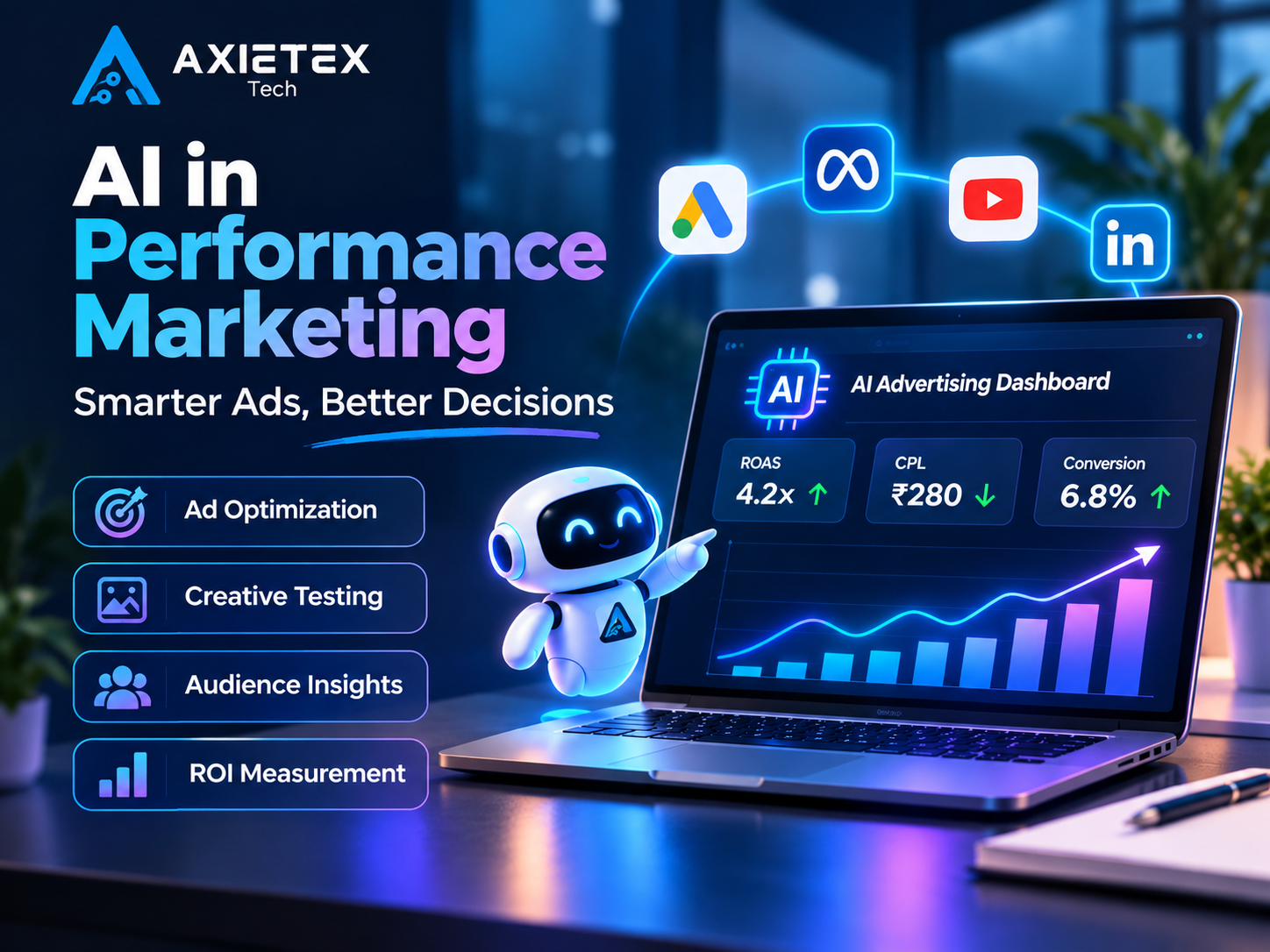
Introduction: The Future of Performance Marketing Is Powered by AI
Digital advertising is becoming more competitive. Businesses are investing in Google Ads, Meta Ads, and other digital platforms to reach potential customers. However, spending more on advertising does not always mean generating better results.
The real challenge is understanding which ads work, which audiences respond, and how to turn advertising spend into measurable business growth.
This is where AI in performance marketing is changing the way businesses approach digital advertising.
Artificial intelligence is helping marketers analyze campaign data, identify patterns, generate creative variations, and make faster optimization decisions. Instead of relying entirely on manual analysis, businesses can use AI-powered tools to make their advertising strategies more data-driven.
In 2026, AI is becoming increasingly integrated into advertising platforms themselves. Meta is expanding AI capabilities across ad creative, ranking, and campaign optimisation, while Google continues to develop AI-powered advertising tools.
For businesses, this creates an opportunity to improve campaign efficiency, understand customers better, and make smarter marketing decisions.
Let’s explore how AI is transforming performance marketing and how businesses can use it effectively.
1. What Is AI in Performance Marketing?
AI in performance marketing refers to the use of artificial intelligence, machine learning, and automation to improve measurable advertising outcomes.
These outcomes may include:
- Generating qualified leads
- Increasing website conversions
- Reducing customer acquisition costs
- Improving return on ad spend (ROAS)
- Increasing sales and revenue
- Identifying high-performing audiences
Traditional performance marketing often involves manually reviewing reports, adjusting campaigns, and testing different advertising approaches.
AI-powered performance marketing adds another layer of intelligence. It can process large amounts of campaign data, recognize patterns, and support faster decision-making.
For example, an AI-powered marketing workflow may help a business:
- Analyze previous campaign performance.
- Identify which creative formats generate more engagement.
- Detect changes in conversion costs.
- Recommend adjustments to campaigns.
- Measure whether those adjustments improve results.
The goal is not simply to use AI because it is trending. The goal is to make advertising decisions based on better information.
2. AI-Powered Ad Optimization
One of the most valuable applications of AI in performance marketing is campaign optimization.
Advertising platforms already use machine learning to help advertisers reach relevant audiences and optimize delivery toward selected objectives.
However, marketers still need to provide the right strategy, conversion signals, creative assets, and campaign structure.
AI can help improve several areas of ad optimization.
Automated bidding and budget optimization
AI-powered advertising systems can analyze signals such as user behavior, conversion likelihood, and campaign performance to optimize bidding and delivery.
For example, a business running Google Ads may use automated bidding to optimize toward conversions or a target return on ad spend.
Similarly, Meta Ads uses machine learning to determine which ads are more likely to generate the desired action.
Identifying performance changes
AI-powered analytics can help marketers identify changes in:
- Cost per lead (CPL)
- Cost per acquisition (CPA)
- Click-through rate (CTR)
- Conversion rate
- Return on ad spend (ROAS)
If a campaign’s cost per lead increases significantly, an AI-assisted analysis may help investigate whether the issue relates to creative fatigue, landing-page performance, audience changes, or conversion tracking.
The important distinction is that AI can identify patterns and suggest actions, while marketers must validate the cause before making significant changes.
3. AI Creative Testing: Finding Ads That Perform Better
Advertising creative has a major influence on campaign performance.
A well-designed advertisement can communicate a value proposition, attract attention, and encourage potential customers to take action.
AI is making creative testing faster and more scalable.
Instead of producing only one advertisement, marketers can develop multiple creative variations for testing.
These variations may include:
- Different headlines
- Alternative hooks
- Different video openings
- Multiple visual concepts
- Different calls to action
- Short-form and long-form video formats
Example: Testing real estate advertisements
Imagine a real estate company promoting a residential project.
The marketing team creates three advertising concepts:
Creative A — Lifestyle-focused
Highlights the lifestyle, amenities, and experience of living in the property.
Creative B — Investment-focused
Highlights location advantages, connectivity, and investment considerations.
Creative C — Price-focused
Highlights the starting price, available configurations, and payment options.
AI can assist in generating variations of these concepts, analyzing creative performance, and identifying patterns in the results.
The marketing team can then use actual campaign data to understand which messaging attracts the most qualified prospects.
However, a creative that generates more clicks is not necessarily the best-performing advertisement.
The final decision should consider lead quality, conversion rates, and business outcomes.
4. AI Audience Insights: Understanding the Right Customers
Reaching the right audience is essential for effective performance marketing.
AI can help marketers understand customer behavior by analyzing campaign interactions, website activity, and available conversion data.
These insights can support better audience strategies.
Audience segmentation
AI-assisted analysis can help identify different customer groups based on their behavior and interests.
For example, a business may discover that:
- Some users engage with educational content.
- Some users visit product or service pages.
- Some users submit enquiries but do not convert.
- Some users are more likely to become paying customers.
Each group may require a different marketing message.
Predictive audience insights
Predictive models can estimate the likelihood of certain actions based on available data.
This may help businesses prioritize audiences, identify potential customer segments, and plan campaigns more effectively.
However, AI audience insights depend on data quality, privacy permissions, and the limitations of the advertising platform.
AI should support audience strategy rather than replace an understanding of customer needs.
5. AI in Advertising ROI Measurement
Generating clicks and impressions is not the same as generating business growth.
A campaign may have an impressive click-through rate but still produce poor-quality leads or low revenue.
This is why measuring advertising ROI is essential.
AI can help marketers analyze campaign performance across multiple metrics and identify which activities contribute to business outcomes.
Important performance marketing metrics
| Metric | What it measures |
|---|---|
| CTR | Percentage of impressions that generate clicks |
| CPC | Average cost per click |
| CPL | Average cost per lead |
| CPA | Cost of acquiring a customer or conversion |
| Conversion Rate | Percentage of visitors completing a desired action |
| ROAS | Revenue attributed to advertising divided by ad spend |
| ROI | Overall return relative to the investment |
For example, if a business spends ₹50,000 on advertising and generates ₹2,00,000 in attributed revenue:
ROAS = ₹2,00,000 ÷ ₹50,000 = 4
This means the campaign generated ₹4 in attributed revenue for every ₹1 spent on advertising.
However, ROAS does not automatically mean the business is profitable. Product costs, operating expenses, agency fees, and other costs must also be considered.
AI-assisted reporting can help connect advertising metrics with broader business performance.
6. How AI Automation Improves Marketing Workflows
Performance marketing involves more than launching advertisements.
Marketers also manage reporting, lead tracking, campaign analysis, follow-ups, and communication between different systems.
AI automation can help reduce repetitive work.
For example, a marketing automation workflow could:
- Collect leads from advertising campaigns.
- Send the leads to a CRM.
- Assign leads to the appropriate sales team.
- Trigger a follow-up notification.
- Track lead status and conversion outcomes.
- Generate campaign performance reports.
This creates a more connected marketing process.
For businesses running lead-generation campaigns, integrating AI with CRM systems can help improve lead management and provide better visibility into the sales pipeline.
At Axietex Tech, AI-powered marketing, automation, CRM integration, and lead-generation solutions can work together to support this process.
7. AI Performance Marketing for Small and Medium Businesses
AI-powered advertising is not limited to large enterprises.
Small and medium-sized businesses can also use AI tools to improve their marketing operations.
Some practical applications include:
Local businesses: Analyze lead-generation campaigns and identify which advertisements generate enquiries.
Real estate companies: Test different property creatives, track lead quality, and automate follow-ups.
E-commerce businesses: Analyze product advertising performance and optimize campaigns toward purchases.
Professional services: Use AI-assisted content testing and lead tracking to improve customer acquisition.
The key is to begin with a clear business objective.
A business does not need dozens of AI tools to start using AI in performance marketing. It needs reliable tracking, a well-defined campaign goal, and a structured process for testing and learning.
8. Challenges of Using AI in Performance Marketing
Although AI offers several advantages, it is not a replacement for strategic marketing expertise.
Businesses should consider the following challenges.
Poor data quality
If conversion tracking is inaccurate, AI systems may optimize toward misleading signals.
Over-reliance on automation
Automated campaigns can still make decisions that do not align with business priorities.
Creative fatigue
AI-generated creative variations do not guarantee fresh or effective messaging.
Inaccurate attribution
Advertising platforms may report conversions differently. Marketers should compare platform data with CRM and business records.
Privacy and data protection
Businesses must ensure that their data collection, customer targeting, and automation practices comply with applicable privacy requirements.
The most effective approach combines AI-powered capabilities with human judgment, accurate data, and clear business objectives.
9. How to Build an AI-Powered Performance Marketing Strategy
Businesses looking to introduce AI into their advertising strategy can follow a structured approach.
Step 1: Define the objective
Decide whether the campaign is designed to generate leads, increase sales, improve website conversions, or achieve another measurable outcome.
Step 2: Establish reliable tracking
Set up conversion tracking using tools such as Google Analytics, Google Tag Manager, Meta Pixel, and CRM integrations where appropriate.
Step 3: Develop creative variations
Create different advertising concepts, messages, and formats for testing.
Step 4: Use AI-powered campaign tools
Leverage relevant platform automation and AI-assisted analysis to improve campaign management.
Step 5: Measure business outcomes
Evaluate lead quality, sales, revenue, and customer acquisition costs instead of focusing only on clicks.
Step 6: Improve continuously
Use performance insights to refine creative strategy, campaign structure, audience approach, and marketing workflows.
This approach allows businesses to use AI as part of a measurable and repeatable growth strategy.
Conclusion: Smarter Advertising Starts With Better Decisions
AI is changing performance marketing by helping businesses analyze data, optimize campaigns, test creative ideas, and improve marketing workflows.
But better advertising results do not come from automation alone.
They come from combining the right strategy, reliable data, relevant creative, and continuous optimization.
Businesses that approach AI performance marketing with a clear understanding of their goals can build more efficient advertising systems and make better-informed decisions.
At Axietex Tech, we help businesses bring together AI-powered marketing, performance advertising, lead generation, and business automation to create connected growth solutions.
Whether you want to improve your advertising campaigns, generate better-quality leads, or automate your marketing operations, the right strategy can help you move toward measurable business growth.
Ready to make your marketing smarter?
Explore AI-powered marketing and automation solutions with Axietex Tech.
Website: https://axietex.com/
Email: admin@axietex.com
Contact: 74500 21121
Frequently Asked Questions
1. What is AI in performance marketing?
AI in performance marketing uses artificial intelligence and machine learning to analyze advertising data, optimize campaigns, improve targeting, and support measurable marketing outcomes.
2. How does AI improve advertising performance?
AI can help identify patterns in campaign data, optimize ad delivery, generate creative variations, and provide insights that support better advertising decisions.
3. Can AI reduce advertising costs?
AI may help improve campaign efficiency and reduce wasted spend. However, results depend on data quality, campaign strategy, creative performance, and market conditions.
4. Is AI performance marketing suitable for small businesses?
Yes. Small businesses can use AI-powered advertising tools, analytics, and automation to improve lead generation, campaign management, and customer acquisition.
5. What is the difference between AI advertising and traditional advertising?
Traditional advertising often relies more heavily on manual analysis and campaign adjustments. AI advertising incorporates machine learning and automation to analyze signals, optimize delivery, and support faster decisions.
6. Does AI replace performance marketers?
No. AI can automate certain tasks and support decision-making, but strategy, creative direction, business understanding, and campaign accountability still require human expertise.