
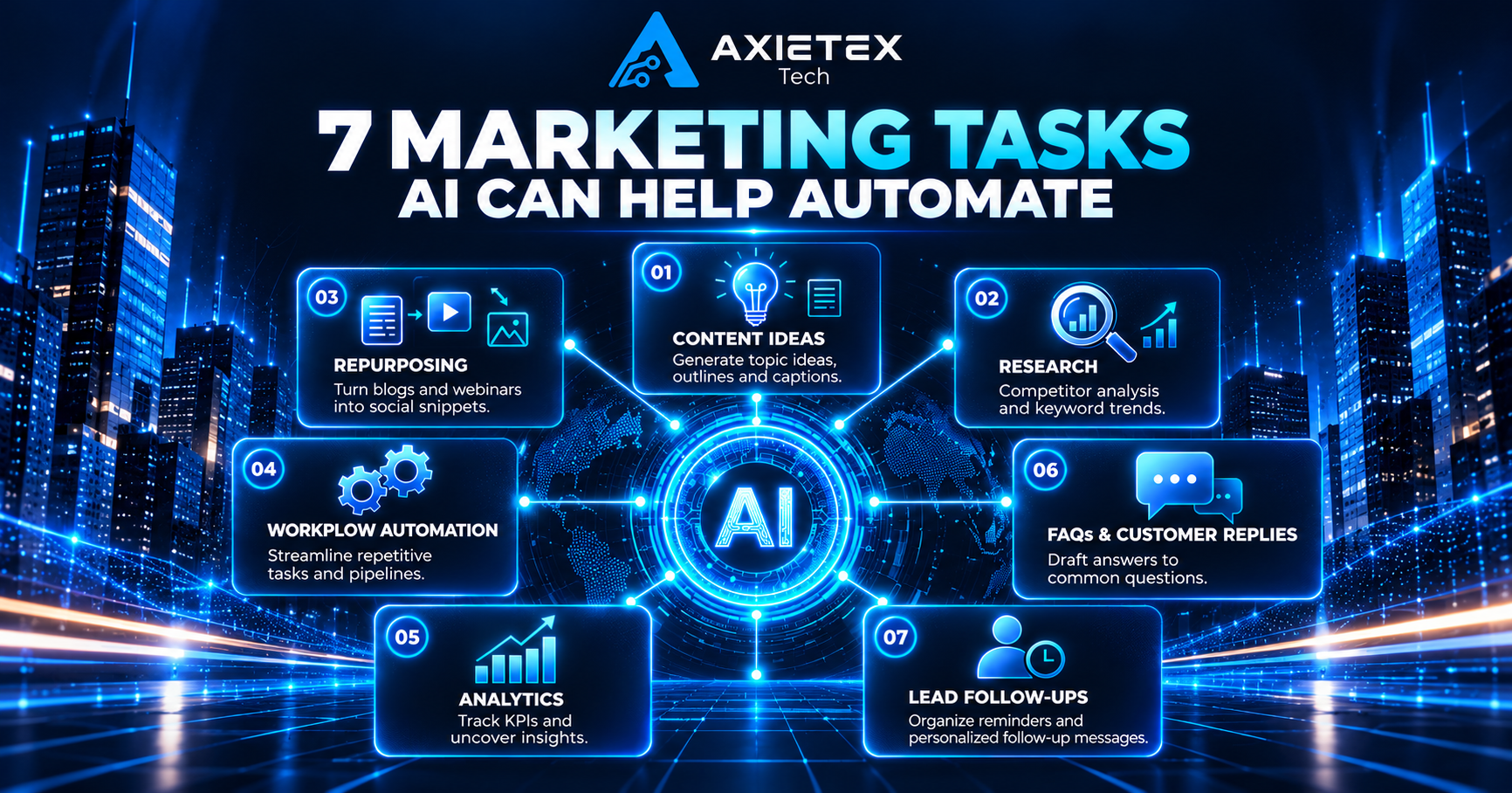
7 Marketing Tasks AI Can Help Automate to Grow Your Business
Artificial intelligence (AI) is changing how businesses plan marketing campaigns, create content, analyse competitors, and manage customer interactions. Tasks that once required hours of manual work can now be streamlined with AI-powered tools and automation workflows.
For businesses looking to improve marketing efficiency, reduce repetitive work, and make better decisions, AI marketing automation offers practical opportunities for growth.
At Axietex Tech, we help businesses explore AI-powered marketing, intelligent automation, and custom AI solutions that simplify workflows and support business growth.
In this blog, we explore seven marketing tasks AI can help automate and how businesses can use these capabilities more effectively.
1. Content Ideas and Content Creation
Creating fresh, relevant content consistently can be challenging for marketing teams. AI tools can help generate content ideas, develop outlines, draft captions, and organise topics for social media, blogs, email campaigns, and other marketing channels.
How AI helps
- Generate blog topic ideas based on target keywords.
- Draft social media captions and post concepts.
- Create initial outlines for articles and landing pages.
- Repurpose existing content into new formats.
- Develop content calendar ideas for different platforms.
For example, a digital marketing agency can use AI to develop a month’s worth of initial content ideas and then refine them according to the client’s audience, brand voice, and marketing goals.
Human review remains important to ensure accuracy, originality, brand consistency, and relevance.
2. Competitor Research and Keyword Analysis
Understanding competitors and identifying relevant search terms are essential parts of an effective digital marketing strategy. AI can support research by helping marketers organise information, identify patterns, and generate keyword ideas.
How AI helps
- Group related keywords by search intent.
- Identify potential content gaps.
- Summarise publicly available competitor information.
- Generate ideas for SEO-focused blog topics.
- Organise research findings into actionable reports.
For instance, a business planning to improve its search visibility can use AI to create an initial keyword map and identify topics worth investigating further.
AI-generated suggestions should be validated using reliable SEO tools, search data, and manual competitor analysis before implementation.
3. Content Repurposing Across Marketing Channels
Producing original content for every platform can consume significant time. Content repurposing allows businesses to turn existing material into different formats for multiple channels.
AI makes this process easier by adapting existing content while preserving its main message.
How AI helps
- Convert blogs into LinkedIn posts.
- Turn webinars into short video scripts.
- Extract key points from long-form videos.
- Transform articles into email newsletter drafts.
- Create multiple social media caption variations.
For example, one detailed blog post can become several social media updates, a newsletter outline, a short video script, and a list of frequently asked questions.
Each version should still be adapted to the platform’s audience and format rather than simply copied everywhere.
4. Marketing Workflow Automation
Marketing involves multiple repetitive activities, from collecting enquiries to assigning leads and updating reports. AI combined with automation platforms can connect these activities and reduce manual intervention.
How AI helps
- Route incoming leads to the appropriate team.
- Trigger follow-up reminders after an enquiry.
- Send internal notifications when specific conditions are met.
- Connect forms, CRM systems, spreadsheets, and marketing tools.
- Automate routine reporting and data organisation.
For example, when a prospective customer submits a website enquiry, an automated workflow can record the lead in a CRM, notify the sales team, and schedule a follow-up task.
AI can add capabilities such as enquiry classification and message summarisation, while rule-based automation handles predictable steps.
Businesses should also implement appropriate access controls, data validation, and human oversight for important customer communications.
5. Marketing Analytics and Performance Reporting
Marketing teams need to understand which campaigns perform well, where budgets are being spent, and which activities deserve further attention.
AI can help organise marketing data and make reports easier to interpret.
How AI helps
- Summarise campaign performance.
- Compare key performance indicators (KPIs).
- Highlight unusual changes in results.
- Organise insights from multiple marketing channels.
- Support reporting on leads, conversions, and engagement.
For example, a business running Google Ads and Meta Ads campaigns can use AI to summarise available performance data and identify questions that require further analysis.
AI should not be treated as a substitute for accurate tracking or statistical analysis. Recommendations must be checked against actual campaign data, attribution settings, and business objectives.
6. FAQs and Customer Reply Assistance
Customers often ask similar questions about pricing, services, availability, delivery, and business processes. AI-powered assistants can help businesses respond more efficiently to common enquiries.
How AI helps
- Draft replies to frequently asked questions.
- Suggest responses to customer messages.
- Summarise conversations for sales teams.
- Help website visitors find relevant information.
- Route complex enquiries to a human representative.
For example, a service-based business can use an AI assistant to answer basic questions about its services and collect relevant information before a sales representative takes over.
AI responses should be based on approved business information. Sensitive requests, complaints, uncertain answers, and important commercial decisions should be escalated to a human when appropriate.
7. Lead Follow-Ups and Customer Relationship Management
Generating leads is only one part of the marketing process. Businesses also need a consistent approach to follow-ups, lead qualification, and customer relationship management.
AI and automation can help teams organise these activities and reduce the likelihood of missed opportunities.
How AI helps
- Classify enquiries based on relevant information.
- Prepare personalised follow-up message drafts.
- Schedule reminders for sales representatives.
- Summarise previous customer interactions.
- Highlight leads that may require attention.
For example, after a prospect enquires about a service, a CRM workflow can assign the lead to a salesperson, create a follow-up task, and maintain a record of the interaction.
Personalisation should use relevant customer information, and automated messages should respect consent, communication preferences, and applicable privacy requirements.
Benefits of AI Marketing Automation for Businesses
When implemented thoughtfully, AI marketing automation can support several business objectives.
Improved operational efficiency
Automating repetitive tasks gives marketing and sales teams more time for planning, creative work, and customer relationships.
More consistent marketing execution
Content workflows, scheduled reminders, and standardised processes help teams maintain consistency across campaigns.
Better use of marketing data
AI-assisted analysis can make large amounts of information easier to review and understand.
More organised lead management
Automated lead assignment, CRM updates, and follow-up reminders can help reduce gaps in the sales process.
Scalable marketing workflows
As a business grows, well-designed automation can help manage increasing workloads without adding unnecessary manual steps to every process.
Results depend on the quality of the data, the tools selected, the workflow design, and how effectively the business measures performance.
How to Start Automating Your Marketing Tasks
Businesses do not need to automate every activity at once. A focused approach is often more practical.
- Identify repetitive tasks. Start with activities that consume time and follow predictable steps.
- Choose one high-value workflow. Content planning, lead assignment, or reporting may be a suitable starting point.
- Select the right tools. Consider your existing CRM, marketing platforms, AI tools, and integration requirements.
- Define clear rules. Specify when automation should run, what information it should use, and when a person must intervene.
- Test before scaling. Review outputs, monitor errors, and check whether the workflow saves time or improves performance.
- Measure the results. Track relevant metrics such as time saved, response time, qualified leads, conversion rate, and campaign performance.
The objective is not to automate everything. It is to identify where AI and automation can deliver practical value to your business.
How Axietex Tech Helps Businesses Explore AI Automation
Axietex Tech works at the intersection of digital marketing, AI-powered solutions, and business process automation.
Our approach focuses on understanding business requirements and identifying opportunities to simplify workflows, improve marketing execution, and organise lead management.
Depending on business needs, this can include AI-powered marketing support, custom automation workflows, lead management processes, CRM integrations, and tailored AI solutions.
Whether you are a small business improving your marketing operations or an established company exploring workflow automation, the first step is identifying the tasks that create the most friction in your current process.
Final Thoughts
AI marketing automation is becoming a useful part of modern business operations. From content creation and competitor research to analytics, customer replies, and lead follow-ups, AI can help businesses reduce repetitive work and organise their marketing activities more effectively.
The best results come from combining AI capabilities with reliable data, clear processes, human judgement, and measurable business objectives.
Start with one task, evaluate the outcome, and expand your automation strategy as your business requirements evolve.
Want to explore AI-powered marketing and automation for your business?
Connect with Axietex Tech to discuss your requirements and identify practical opportunities for improvement.
Website: Axietex Tech
Frequently Asked Questions
1. What marketing tasks can AI automate?
AI can assist with content ideation, keyword research, content repurposing, workflow automation, analytics reporting, FAQ responses, and lead follow-ups.
2. Is AI marketing automation suitable for small businesses?
Yes. Small businesses can start with focused workflows such as content planning, enquiry management, follow-up reminders, and basic reporting.
3. Can AI replace a digital marketing team?
AI can support and automate selected tasks, but strategy, creative judgement, customer relationships, quality control, and business decisions still require human involvement.
4. What tools are used for AI marketing automation?
Depending on the workflow, businesses may use generative AI tools, CRM platforms, analytics software, email marketing systems, and automation platforms such as n8n or other integration tools.
5. How can a business measure the success of AI automation?
Relevant metrics include time saved, cost per lead, lead response time, conversion rate, content production time, and the accuracy and reliability of automated workflows.