
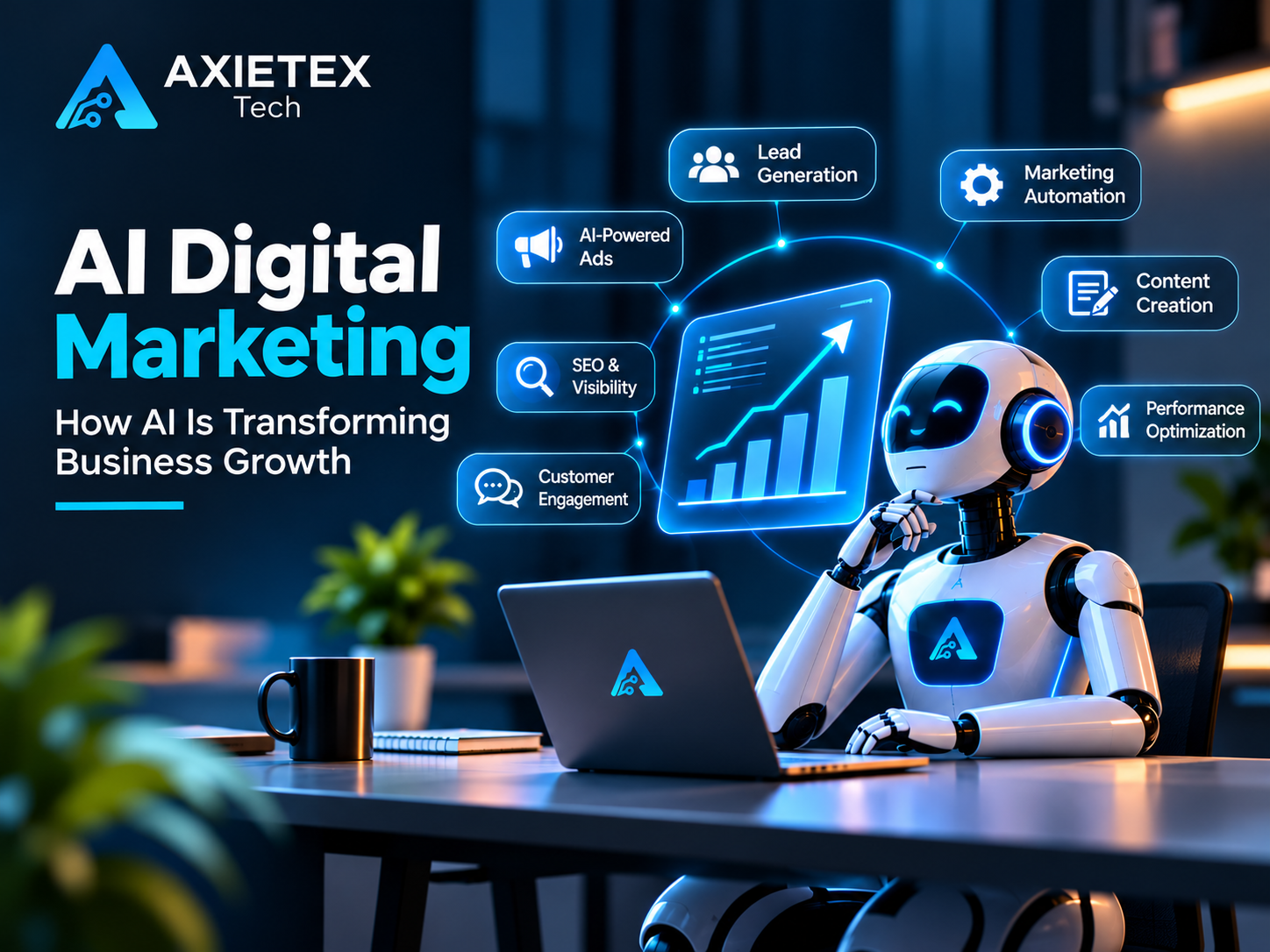
AI in Digital Marketing: How Artificial Intelligence Is Transforming Business Growth
A Complete Guide to AI Digital Marketing, Automation, Lead Generation, and Campaign Optimization
Digital marketing is becoming more data-driven, automated, and personalized. Businesses are no longer relying only on traditional marketing methods to attract customers. Artificial intelligence (AI) is helping companies understand customer behaviour, improve advertising campaigns, automate repetitive tasks, and create more relevant marketing experiences.
From AI-powered content creation to automated lead generation and campaign optimization, artificial intelligence is changing how businesses plan and execute their digital marketing strategies.
But what exactly is AI digital marketing, and how can businesses use it to improve their marketing performance?
In this guide, we will explore how AI is used in digital marketing, its benefits, practical applications, and how businesses can implement AI-powered marketing strategies.
What Is AI Digital Marketing?
AI digital marketing refers to the use of artificial intelligence technologies to plan, execute, analyse, and optimize digital marketing activities.
These technologies can process large amounts of data, identify patterns, generate content, predict customer behaviour, and automate selected marketing workflows.
AI digital marketing can include:
- AI-powered content creation
- Search engine optimization (SEO)
- Automated email marketing
- AI-powered advertising optimization
- Customer behaviour analysis
- Lead generation and qualification
- Marketing chatbots and voice agents
- CRM and workflow automation
For example, a business running Google Ads and Meta Ads campaigns can use AI-powered features to analyse campaign data, identify patterns, and support optimization decisions.
Similarly, an AI-enabled CRM can help organize leads, prioritize follow-ups, and identify potential sales opportunities.
The goal is not simply to use more technology. It is to make marketing processes more efficient, measurable, and relevant to customers.
How Does AI Work in Digital Marketing?
AI digital marketing generally involves three important capabilities.
1. Data Analysis and Customer Insights
AI systems can analyse customer interactions, website behaviour, campaign performance, and other available data to identify patterns.
Businesses can use these insights to understand:
- Which marketing channels generate enquiries
- Which campaigns attract relevant customers
- What customers are searching for
- Which pages receive the most engagement
- Where potential customers leave the conversion process
These insights can help marketers make more informed decisions about targeting, messaging, and budget allocation.
2. Content Generation and Personalization
Generative AI can assist with creating marketing content, including:
- Blog articles and website copy
- Social media captions
- Advertising headlines
- Email drafts
- Creative concepts
- Video scripts
AI can also help personalize marketing messages based on customer interests, behaviour, and preferences when appropriate data is available.
Human review remains important to ensure that the content is accurate, useful, original, and aligned with the brand’s voice.
3. Marketing Automation
AI can support automated workflows that respond to customer actions or specific business conditions.
For example, when someone submits a website enquiry, an automated workflow could:
- Capture the lead details.
- Add the lead to a CRM.
- Categorize the enquiry.
- Send an acknowledgement.
- Assign the lead to a sales representative.
- Schedule a follow-up reminder.
This reduces repetitive manual work and helps businesses maintain a more organized lead management process.
7 Ways AI Is Transforming Digital Marketing
1. AI-Powered Lead Generation
Lead generation is one of the most important activities for businesses that depend on enquiries and sales opportunities.
AI can support lead generation by analysing campaign performance, identifying relevant audience patterns, and helping businesses improve their lead capture process.
For example, a real estate company can use AI-powered marketing workflows to collect property enquiries, identify buyer preferences, and organize potential customers according to their requirements.
AI-powered lead qualification can also help sales teams prioritize enquiries based on factors such as budget, interest, and buying timeline.
However, lead quality still depends on the offer, targeting, campaign strategy, and the quality of the data being collected.
2. Smarter Advertising Campaigns
AI is increasingly integrated into advertising platforms such as Google Ads and Meta Ads.
Depending on the campaign type and settings, AI-powered advertising features can assist with:
- Audience matching
- Bid optimization
- Creative variation
- Campaign performance analysis
- Conversion optimization
Marketers can use these features to test different messages and understand which approaches generate meaningful results.
The most effective strategy combines platform automation with clear campaign objectives, reliable conversion tracking, and human decision-making.
3. AI-Powered Search Engine Optimization
AI can support SEO activities such as keyword research, content planning, competitor analysis, and search intent classification.
It can help marketers identify relevant topics and structure content around the questions customers are asking.
For example, a business offering digital marketing services in India could create useful content around topics such as:
- AI digital marketing for small businesses
- Digital marketing automation
- AI-powered lead generation
- Digital marketing services in India
- AI marketing tools for businesses
AI should be used to support research and content development, not to generate large volumes of repetitive pages without meaningful value.
Google recommends creating helpful, reliable, people-first content that demonstrates expertise and provides value to readers. <Cite refs={[“turn733339search0″,”turn733339search8”]}/>
4. Personalized Email Marketing
Email marketing becomes more effective when messages are relevant to the recipient.
AI can help businesses analyse engagement patterns, organize customer segments, and assist with personalized email content.
For example, an online business may create different email workflows for:
- New subscribers
- Customers who requested a quotation
- Existing customers
- Customers who have not engaged recently
With suitable automation and customer data, businesses can send relevant messages based on the customer’s stage in the buying journey.
Personalization should be based on appropriate data use and respect customer preferences and consent.
5. AI Chatbots and Voice Agents
AI-powered chatbots and voice agents can help businesses respond to customer enquiries, answer common questions, collect lead information, and support appointment scheduling.
A chatbot can interact with website visitors, while an AI voice agent can handle suitable phone conversations.
For example, a potential customer visiting a business website after office hours may ask about services, pricing, or consultation availability.
An AI assistant can provide approved information and collect the customer’s contact details for follow-up.
When integrated with a CRM, these interactions can become part of a broader lead management workflow.
6. Predictive Marketing Analytics
Predictive analytics uses historical data and statistical or machine-learning models to estimate future outcomes.
In marketing, it may help businesses understand:
- Which leads may be more likely to convert
- Which customers may need follow-up
- Which campaigns are showing promising trends
- Which customer segments may respond to specific offers
These predictions are not guarantees. Their usefulness depends on data quality, model performance, and the business context.
When used carefully, predictive analytics can help marketers prioritize resources and make more informed decisions.
7. Automated Customer Follow-Ups
Many businesses lose opportunities because enquiries are not followed up consistently.
AI and workflow automation can help businesses create structured follow-up processes.
For example, a lead management workflow may:
- Send an acknowledgement after an enquiry
- Notify a sales representative
- Create a follow-up task
- Send a reminder when an action is overdue
- Update the lead status after a response
This can improve operational consistency and reduce the risk of enquiries being overlooked.