
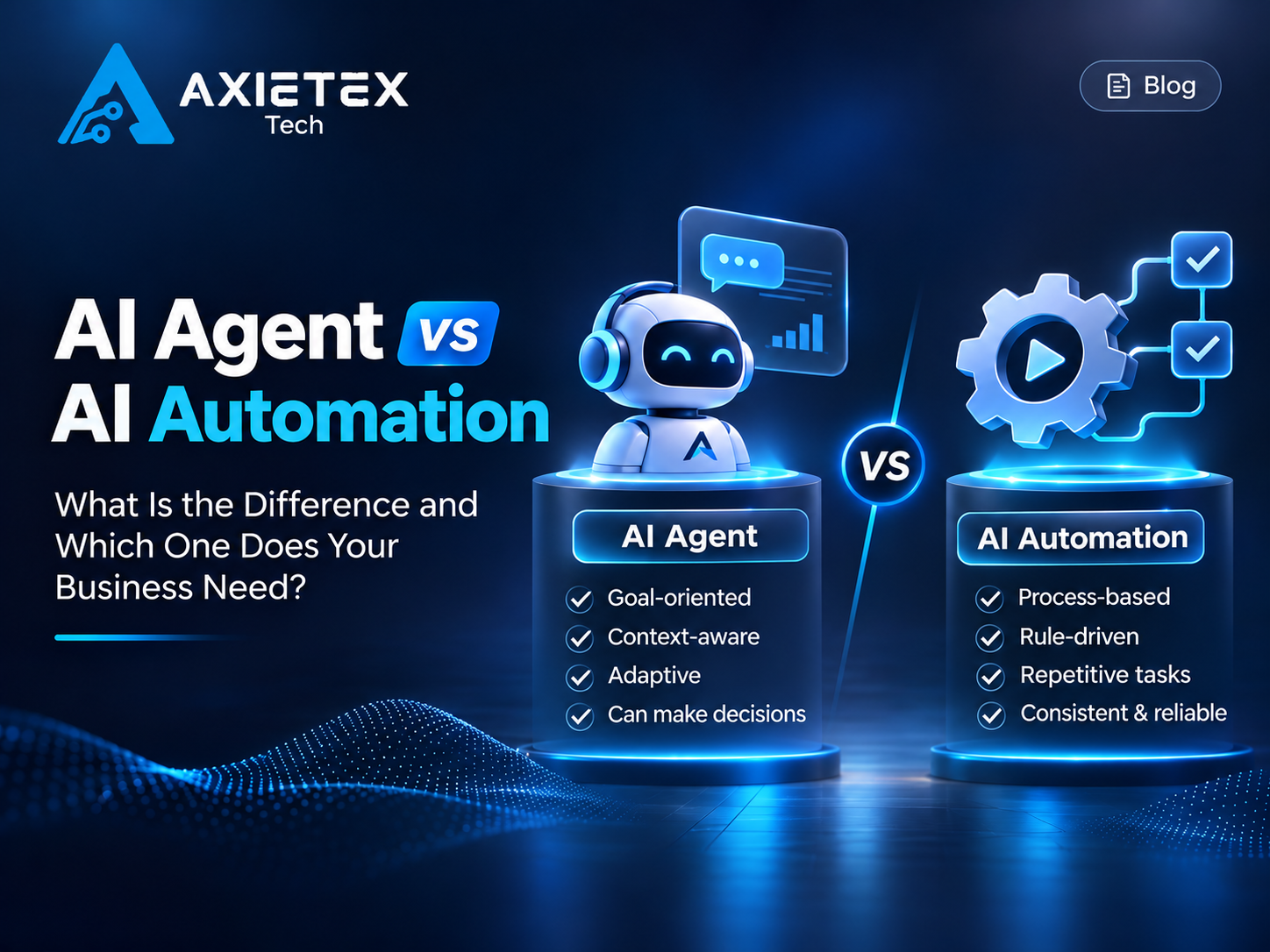
AI Agents vs AI Automation: What Is the Difference and Which One Does Your Business Need?
Meta Title: AI Agents vs AI Automation: Key Differences for Businesses
Meta Description: Discover the difference between AI Agents and AI Automation, how they work, and which technology can help your business improve productivity and growth.
Primary Keyword: AI Agents vs AI Automation
Secondary Keywords: AI Business Automation, AI Agents for Business, Business Process Automation, AI Workflow Automation
Introduction
Artificial Intelligence is changing the way businesses operate. From managing customer inquiries to automating repetitive tasks, AI is helping companies improve efficiency, reduce operational costs, and make better decisions.
Two technologies gaining significant attention are AI Agents and AI Automation.
Although these terms are often used interchangeably, they serve different purposes. AI Automation focuses on automating predefined processes, while AI Agents can understand goals, make decisions, and take actions based on changing situations.
Understanding the difference between these technologies can help businesses choose the right solution for their operational needs.
In this blog, we will explore how AI Agents and AI Automation work, their key differences, practical business applications, and how to determine which solution is right for your business.
What Is AI Automation?
AI Automation combines artificial intelligence with automated workflows to perform business tasks with minimal human intervention.
Traditional automation follows predefined rules. AI-powered automation goes a step further by using AI to process information, recognize patterns, understand text, and make certain decisions within a workflow.
For example, imagine a business receiving hundreds of customer inquiries every day.
An AI-powered automation system can:
- Capture customer inquiries from a website.
- Extract relevant information from messages.
- Categorize inquiries based on customer requirements.
- Add customer details to a CRM.
- Send automated email or WhatsApp responses.
- Notify the appropriate sales representative.
Once configured, the workflow executes automatically whenever the required conditions are met.
Key Characteristics of AI Automation
Rule-based workflows: Tasks follow predefined triggers and conditions.
Consistent execution: The same process is repeated reliably.
Reduced manual work: Employees spend less time on repetitive tasks.
Predictable outcomes: The workflow operates within its configured boundaries.
AI Automation is particularly useful when businesses have repetitive processes that follow a consistent structure.
What Is an AI Agent?
An AI Agent is an AI-powered system that can understand a goal, interpret available information, decide what action to take, and use connected tools to accomplish a task.
Unlike a conventional automated workflow, an AI Agent can adapt its actions based on the context of a situation.
For example, consider an AI sales agent working for a real estate company.
A customer sends the following message:
“I am looking for a 3 BHK apartment in Newtown with a budget of around ₹90 lakh. I want to move within the next six months.”
An AI Agent can:
- Understand the customer’s property requirements.
- Identify the customer’s budget and preferred location.
- Search available property listings through connected systems.
- Identify suitable properties.
- Ask relevant follow-up questions.
- Update the CRM with the customer’s requirements.
- Recommend the next action to the sales team.
The agent does not necessarily follow the exact same sequence for every customer. It can adjust its approach based on the information received.
Key Characteristics of AI Agents
Goal-oriented: The agent works toward achieving a defined objective.
Context-aware: It can interpret information from conversations and connected data.
Adaptive: It can change its approach when circumstances change.
Tool-enabled: It can interact with approved systems, APIs, and business applications.
AI Agents are particularly useful when tasks involve different situations, incomplete information, or decisions that require contextual understanding.
AI Agents vs AI Automation: Key Differences
| Feature | AI Automation | AI Agents |
|---|---|---|
| Primary purpose | Automate predefined workflows | Achieve goals through decisions and actions |
| Workflow | Structured and predefined | Can adapt based on context |
| Decision-making | Rules and configured AI steps | AI-driven reasoning within defined boundaries |
| Flexibility | Best for predictable processes | Best for changing situations |
| Human involvement | Usually required for setup and exceptions | Required for oversight and sensitive decisions |
| Example | Automatically assign leads to sales agents | Understand customer needs and recommend suitable properties |
The most important distinction is that AI Automation executes a process, while an AI Agent can determine how to approach a task within its permitted capabilities.
However, not every AI Agent is fully autonomous, and not every automation workflow is limited to simple rules. Modern business systems often combine both technologies.
Real-World Business Examples
1. Customer Support
AI Automation:
Automatically sends order confirmations, delivery notifications, and predefined responses to common questions.
AI Agent:
Understands a customer’s issue, checks connected order information, identifies possible solutions, and escalates complex cases to a human support representative.
2. Sales and Lead Generation
AI Automation:
Captures leads from advertising campaigns, assigns them to sales representatives, and schedules follow-up reminders.
AI Agent:
Engages with prospective customers, understands their requirements, qualifies leads, and recommends appropriate follow-up actions.
3. Marketing Operations
AI Automation:
Schedules social media posts, generates campaign reports, and sends notifications when campaign performance changes.
AI Agent:
Analyzes campaign information, identifies possible performance issues, suggests improvements, and prepares recommendations for marketing teams.
4. Business Administration
AI Automation:
Organizes documents, generates recurring reports, and sends invoice reminders.
AI Agent:
Reviews incoming documents, identifies relevant information, answers questions about business records, and assists with administrative tasks through connected tools.
Which One Should Your Business Choose?
The right technology depends on the complexity of your business processes.
Choose AI Automation When:
- Your business has repetitive tasks.
- The workflow follows a predictable structure.
- You want to reduce manual data entry.
- You need consistent execution.
- You want to connect different software applications.
Examples include CRM updates, lead assignment, invoice reminders, and scheduled reporting.
Choose AI Agents When:
- Tasks require understanding customer conversations.
- Different situations require different actions.
- Your business needs contextual decision-making.
- Employees spend time researching or interpreting information.
- You want an AI system to work toward a defined goal.
Examples include AI sales assistants, customer support agents, and AI-powered business research systems.
Choose Both When:
Your business needs a combination of structured processes and intelligent decision-making.
For example, an AI Agent can qualify a customer lead, while AI Automation handles CRM updates, notifications, and follow-up scheduling.
This creates a connected system where intelligent decisions and reliable workflows work together.
The Future of Business: AI Agents + AI Automation
Businesses do not necessarily need to choose between AI Agents and AI Automation.
In many cases, the most effective approach is to combine both technologies.
An AI Agent can handle tasks that require contextual understanding, while automation ensures that the resulting actions are executed consistently.
For example, an AI-powered sales system can:
- Receive a new customer inquiry.
- Use an AI Agent to understand the customer’s needs.
- Identify the appropriate sales representative.
- Automatically update the CRM.
- Schedule a follow-up.
- Notify the sales team.
- Track the lead’s progress.
This combination can help businesses reduce repetitive work, improve customer experiences, and create more efficient operations.
The key is to identify which tasks require intelligence and which tasks require reliable execution.
How Axietex Tech Helps Businesses Implement AI
At Axietex Tech, we help businesses explore practical AI solutions that align with their operational requirements and growth objectives.
Our AI-powered solutions focus on improving business efficiency through intelligent systems and connected workflows.
Our services include:
AI Agent Development
Developing AI-powered agents for customer support, lead qualification, business assistance, and other operational requirements.
AI Business Automation
Automating repetitive business processes, connecting applications, and reducing manual operational work.
CRM and Workflow Integration
Connecting AI solutions with existing CRM systems, marketing platforms, and business applications.
Custom AI Solutions
Designing AI-powered systems based on specific business requirements, workflows, and operational challenges.
Our approach focuses on practical implementation, measurable business value, and solutions that can evolve with your business.
Conclusion
AI Agents and AI Automation are two powerful technologies that can help businesses improve productivity and operational efficiency.
AI Automation is ideal for repetitive, structured processes. AI Agents are more suitable for tasks that require contextual understanding, decision-making, and adaptability.
For many businesses, combining both technologies can create a more efficient and intelligent operational system.
The right solution begins with understanding your business challenges, identifying opportunities for improvement, and implementing the technology that delivers the most value.
Ready to explore AI Agents or AI Automation for your business?
Axietex Tech can help you identify opportunities, design intelligent workflows, and develop AI-powered solutions aligned with your business goals.
Contact Axietex Tech to discuss your AI automation requirements.
Website: https://axietex.com