
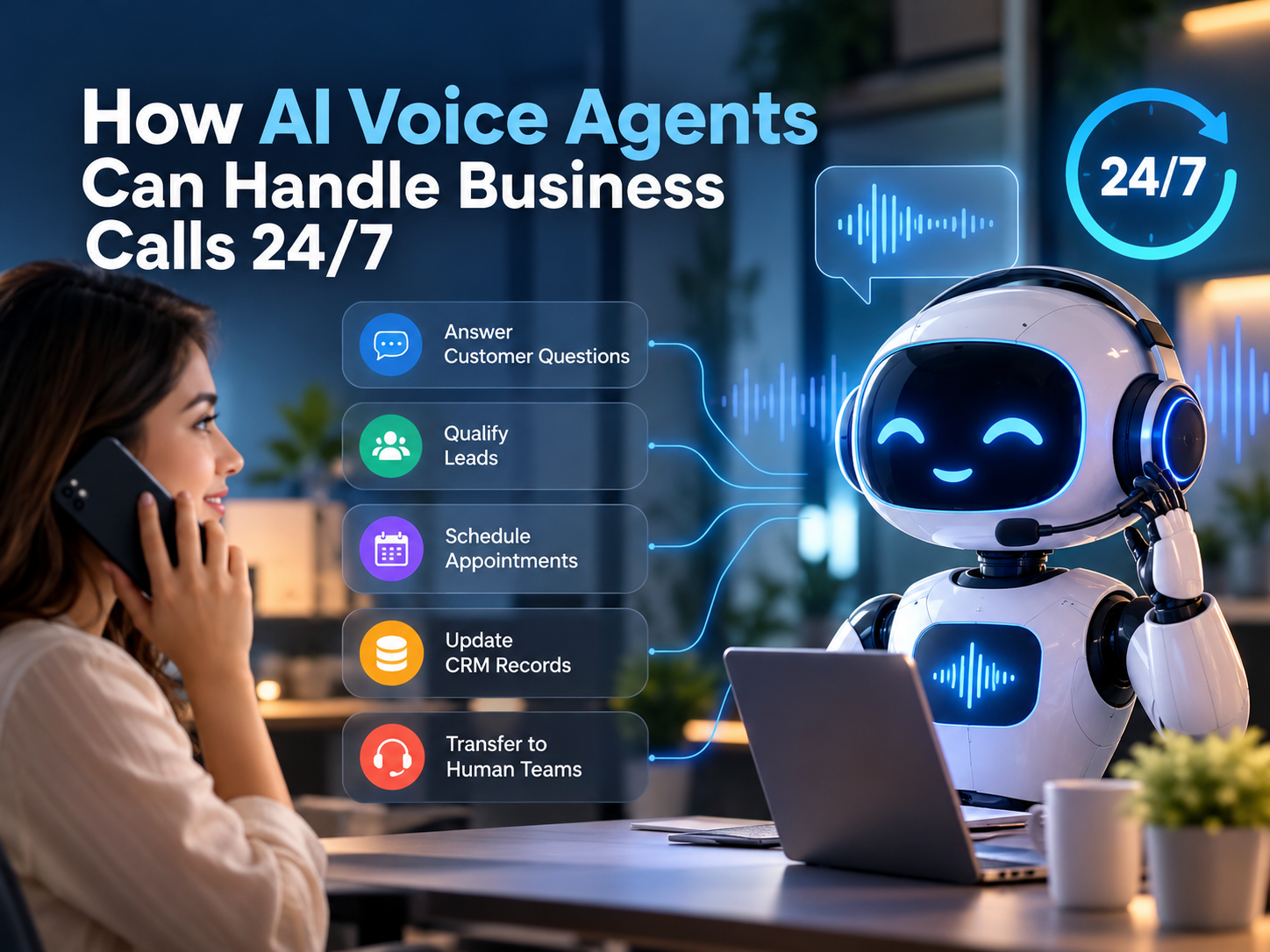
How AI Voice Agents Can Handle Business Calls 24/7
AI Voice Agents for Business | Customer Support Automation | Axietex Tech
Imagine a potential customer calling your business at midnight. Your office is closed, your team is unavailable, and the customer needs an immediate answer. What happens next? In many businesses, the call goes unanswered, and the opportunity may be lost.
This is where AI voice agents can make a difference.
AI voice agents help businesses manage incoming and outgoing phone calls using artificial intelligence, speech recognition, and natural language processing. They can answer common questions, collect customer information, qualify leads, schedule appointments, and route calls to the right team — even outside regular business hours.
For businesses looking to improve customer communication and reduce repetitive manual work, AI voice agents offer a practical approach to call automation.
In this guide, we will explore how AI voice agents work, their key benefits, real-world applications, and how businesses can start using them.
What Are AI Voice Agents?
AI voice agents are AI-powered systems that communicate with people through spoken conversations over phone calls or supported voice platforms.
Unlike traditional IVR systems that rely heavily on fixed menus and button presses, conversational AI voice agents can understand spoken requests and respond based on the conversation, within their configured capabilities.
For example, a customer might say:
“I want to know more about your services and book a consultation tomorrow.”
An AI voice agent can identify the customer’s intent, ask relevant follow-up questions, check available appointment slots if connected to a scheduling system, and help complete the booking.
Depending on the setup, an AI voice agent may integrate with a CRM, calendar, customer database, or business software to retrieve information and perform specific actions.
How Do AI Voice Agents Handle Business Calls 24/7?
AI voice agents can be configured to handle calls continuously, provided the telephony service, software, integrations, and supporting infrastructure remain operational.
Here is how the process typically works.
1. Answer Incoming Calls Automatically
When a customer calls a business number connected to the AI voice system, the agent can answer the call without waiting for a human receptionist.
It can greet callers, identify their needs, and provide relevant information based on approved business knowledge.
This can help businesses respond to customers during evenings, weekends, holidays, and busy periods.
2. Understand Customer Questions
Speech recognition converts the caller’s speech into information the AI system can process. Language models and conversation logic help interpret the request and generate a suitable response. Text-to-speech technology then delivers that response as spoken audio.
For example, a customer may ask about service pricing, business hours, product availability, or appointment procedures.
The agent can answer questions when reliable information is available in its knowledge base or connected systems. If it cannot confidently answer, it should clarify the question or transfer the caller to a human representative.
3. Qualify Leads Automatically
Lead qualification is one of the most useful applications of AI voice agents.
When someone calls to enquire about a product or service, the agent can ask questions such as:
- What service are you interested in?
- What is your approximate budget?
- When are you planning to make a decision?
- What is the best time for our team to contact you?
With the appropriate CRM integration, the agent can save the responses, categorise the enquiry, and notify the sales team.
This allows sales representatives to prioritise relevant leads instead of manually collecting the same information during every initial call.
4. Schedule Appointments and Callbacks
AI voice agents can help customers book consultations, request callbacks, or reschedule appointments.
When connected to a calendar or booking system, the agent can check available slots and confirm appointments based on current availability.
For example, a real estate agency could use a voice agent to collect a buyer’s preferred property type, budget, and site-visit timing before recording the enquiry in its CRM.
The actual booking depends on the integrations, permissions, and scheduling rules configured for the business.
5. Update CRM Records
Manual data entry after every phone call can consume valuable working hours.
An integrated AI voice agent can record relevant call details, such as:
- Customer name and contact information
- Reason for calling
- Product or service interest
- Lead qualification details
- Requested callback time
- Next follow-up action
These details can be saved in a connected CRM or business database, subject to the system’s permissions and data-handling policies.
The result is a more organised process for tracking enquiries and managing customer conversations.
6. Transfer Complex Calls to Human Teams
Not every customer interaction should be automated.
Some callers may have complicated questions, billing disputes, urgent requirements, or requests that require human judgement.
A well-designed AI voice agent can recognise configured escalation conditions and transfer the call to an available employee. If nobody is available, it can collect the caller’s details and arrange a callback.
The goal is not necessarily to replace human communication. It is to let AI handle suitable routine tasks while keeping human support available for situations that need it.
Key Benefits of AI Voice Agents for Businesses
1. Continuous Call Availability
Customers can receive assistance beyond standard office hours. This is particularly useful for businesses that receive enquiries in different time zones or outside traditional working hours.
2. Reduced Repetitive Work
AI can handle routine questions, initial lead qualification, and basic appointment requests. This gives employees more time to focus on sales, customer relationships, and complex tasks.
3. Faster Lead Response
When a potential customer calls, a configured voice agent can respond immediately rather than waiting for a sales representative to become available.
Faster responses can improve the customer experience, although actual conversion results depend on lead quality, the offer, and the sales process.
4. More Consistent Customer Communication
A voice agent follows its configured instructions, business information, and workflows. This can help maintain consistency across common customer interactions.
Its knowledge base must be kept up to date, and its responses should be tested regularly to reduce errors.
5. Scalable Call Handling
Businesses with fluctuating call volumes may use AI voice agents to handle multiple conversations, depending on their provider’s concurrency limits, telephony capacity, and software configuration.
This can reduce the need to increase human staffing solely to manage routine call spikes.
6. Better Lead Tracking
When call information is captured in a CRM, managers can review enquiry sources, common customer questions, lead qualification outcomes, and follow-up requirements.
These insights can help businesses improve their marketing and sales processes.
Which Industries Can Benefit from AI Voice Agents?
AI voice agents can support a variety of industries when the conversation workflows are designed around their needs.
Real Estate
Real estate businesses can use AI voice agents to respond to property enquiries, collect buyer preferences, qualify budgets, and arrange site visits.
Healthcare and Clinics
Clinics may use voice automation for appointment requests, opening-hour information, and routine administrative reminders. Sensitive medical questions should be handled within appropriate clinical and privacy safeguards.
E-commerce
Online stores can automate basic questions about order status, delivery procedures, returns policies, and customer support routing when connected to the relevant systems.
Travel and Hospitality
Travel agencies and hospitality businesses can use voice agents to answer package enquiries, collect travel preferences, record booking requests, and arrange callbacks.
Education and Training
Educational institutions can automate initial course enquiries, collect prospective student information, share approved course details, and schedule counselling sessions.
Professional Services
Consultancies, marketing agencies, and service providers can use AI voice agents to capture enquiries, explain standard service information, and arrange introductory consultations.
AI Voice Agents vs Traditional IVR Systems
| Feature | Traditional IVR | AI Voice Agent |
|---|---|---|
| Customer interaction | Fixed menus and options | Conversational speech |
| Understanding requests | Usually menu-based | Can interpret natural language |
| Lead qualification | Often requires manual handling | Can ask configured questions |
| CRM integration | Depends on the system | Available through suitable integrations |
| Complex enquiries | Usually routed through predefined options | Can clarify or escalate within configured limits |
| Availability | Depends on telephony setup | Can operate continuously when the system is available |
Both solutions have their place. Traditional IVR may be sufficient for simple call routing, while AI voice agents can be useful when a business needs more flexible conversations and automated workflows.
How Much Does an AI Voice Agent Cost?
The cost of implementing an AI voice agent depends on the complexity of the system and how it is deployed.
Typical cost components include:
- Telephony charges for incoming or outgoing calls
- Speech recognition and text-to-speech usage
- AI model or voice-agent platform fees
- CRM, calendar, and software integrations
- Development, testing, and maintenance
A basic enquiry-handling agent may be relatively straightforward to implement. A more advanced system with multiple languages, outbound campaigns, CRM updates, custom business logic, and analytics will generally require more work.
Businesses should evaluate the total cost per completed conversation, not just the AI software fee. Testing, failed calls, call duration, concurrency, and human escalation can all affect the overall economics.
How to Implement AI Voice Agents in Your Business
A practical implementation usually involves the following steps.
Step 1: Identify repetitive calls. List the questions customers ask most frequently and identify which calls can safely be automated.
Step 2: Define the conversation flow. Create the greeting, qualification questions, approved answers, escalation rules, and call-ending process.
Step 3: Connect your business phone system. Choose a suitable telephony provider and configure the incoming or outgoing call workflow.
Step 4: Integrate your CRM and business tools. Connect the systems needed to save enquiries, retrieve approved information, schedule appointments, or notify employees.
Step 5: Test real-world conversations. Evaluate different accents, background noise, interruptions, ambiguous questions, and unexpected customer requests.
Step 6: Launch with a limited workflow. Start with a specific use case, monitor performance, and expand automation once the system meets your quality requirements.
Step 7: Monitor and optimise. Review call outcomes, customer feedback, successful transfers, booking rates, and the accuracy of CRM updates.
Businesses operating in India should also assess applicable privacy, consent, telemarketing, and telecommunications requirements before deploying voice automation, particularly for outbound calls and the handling of personal information.
Why Businesses Are Exploring AI Voice Automation
Customer expectations around responsiveness continue to make call handling an important part of business operations. At the same time, employees often spend significant time answering repetitive questions and collecting basic information.
AI voice agents offer a way to automate suitable interactions while maintaining a clear path to human support.
The most effective implementation is not necessarily the one that automates every call. It is the one that identifies where automation creates genuine value, integrates reliably with existing workflows, and provides an appropriate experience for customers.
For businesses evaluating this technology, starting with one well-defined use case — such as after-hours enquiry handling, lead qualification, or appointment scheduling — can make implementation easier to measure and improve.
Build Smarter Business Communication with Axietex Tech
At Axietex Tech, we focus on AI-powered business solutions, workflow automation, lead management, and digital growth systems designed around practical business needs.
AI voice automation can be part of a broader system that connects customer calls with lead management, follow-ups, and sales workflows.
If your business wants to explore how AI voice agents could support its customer communication process, our team can help you assess the use case and identify a suitable automation approach.
Ready to explore AI voice automation for your business?
Visit Axietex Tech to learn more about our AI and automation solutions, or contact our team to discuss your requirements.
Frequently Asked Questions
1. Can AI voice agents answer business calls 24/7?
Yes. They can be configured to answer calls around the clock, provided the phone service, AI platform, and required integrations are operational.
2. Can AI voice agents speak Indian languages?
Many voice platforms support multiple languages and accents, including some Indian languages. Actual quality varies by provider, language, voice model, and background noise, so testing with your target audience is important.
3. Can an AI voice agent generate leads?
Yes. It can ask qualification questions, capture customer details, identify service interests, and send the information to a connected CRM. Lead quality depends on the conversation design and the business’s targeting and sales process.
4. Can AI voice agents integrate with a CRM?
Yes. Depending on the available APIs and integrations, they can create or update lead records, log call outcomes, and trigger follow-up workflows.
5. Do AI voice agents replace human call centre employees?
Not necessarily. They are often most useful for routine enquiries and repetitive workflows, while human employees handle complex, sensitive, or high-value conversations.
6. Are AI voice agents suitable for small businesses?
They can be suitable for small businesses that receive enough calls or miss enough enquiries to justify the implementation and ongoing costs. A limited pilot can help determine whether the solution is worthwhile.
7. What should a business consider before deploying an AI voice agent?
Businesses should evaluate call quality, language support, integration requirements, pricing, privacy and consent obligations, escalation options, reliability, and measurable business outcomes.
About Axietex Tech
Axietex Tech provides AI-powered marketing, business automation, lead generation, and technology solutions to help businesses improve their digital operations.
Suggested internal links: AI Automation Services, AI Agents Development, CRM Solutions, Lead Generation Services, and Contact Axietex Tech.