
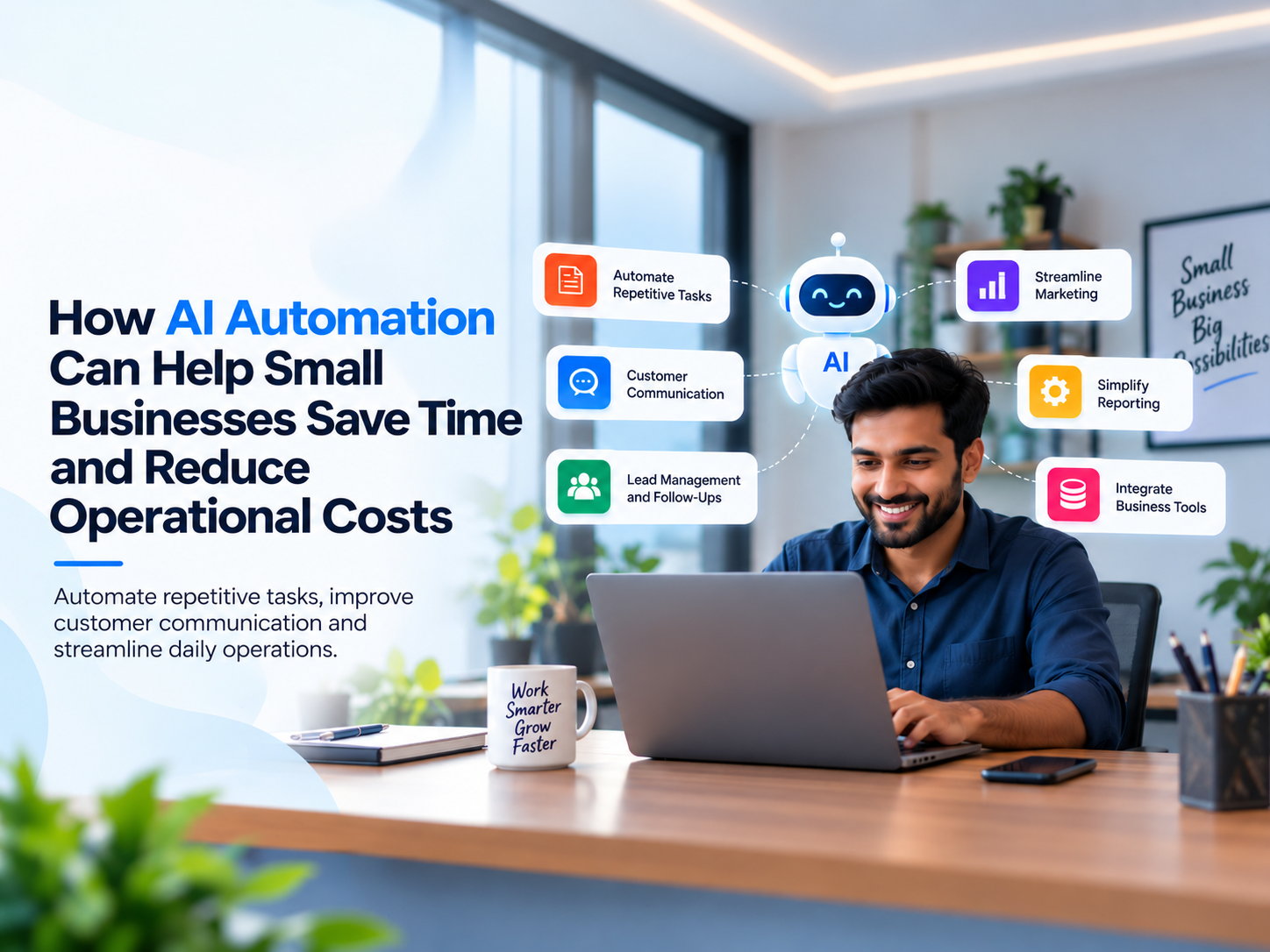
How AI Automation Can Help Small Businesses Save Time and Reduce Operational Costs
Small businesses often operate with limited resources while managing multiple responsibilities, including customer communication, marketing, sales, administration, and reporting. As a business grows, these daily activities can consume valuable time and increase operational expenses.
AI automation for small businesses offers a practical way to simplify repetitive tasks, improve operational efficiency, and help teams focus on business growth rather than manual work.
By combining artificial intelligence (AI), workflow automation, and business software integration, companies can streamline everyday operations, improve customer experiences, and make better use of their existing resources.
In this guide, we explore how AI automation works, which business processes can be automated, how much time businesses could potentially save, and how to get started.
What Is AI Automation for Small Businesses?
AI automation combines artificial intelligence with automated workflows to perform tasks that would otherwise require repeated manual effort.
Traditional automation follows predefined rules to complete specific actions. AI-powered automation can also analyse information, classify enquiries, summarise messages, generate content, and assist with decisions based on available data.
For example, when a potential customer submits an enquiry through a website, an automated workflow can capture the information, add the lead to a customer relationship management (CRM) system, assign it to a sales representative, and send an acknowledgement.
AI can also help categorise the enquiry according to the customer’s requirements, allowing the team to organise and prioritise incoming leads.
Instead of managing every step manually, employees can focus on activities that require human judgement, relationship building, and decision-making.
7 Ways AI Automation Can Help Small Businesses
1. Automate Repetitive Administrative Tasks
Administrative work is essential for running a business, but many routine activities do not require constant human involvement.
Small businesses often spend hours updating spreadsheets, transferring information between applications, preparing routine documents, organising records, and sending internal reminders.
AI automation can help streamline these activities through:
- Automatically transferring information between connected business applications.
- Organising customer records and incoming documents.
- Generating routine reports and summaries.
- Extracting relevant information from supported documents.
- Sending reminders for appointments, deadlines, and pending tasks.
- Updating records when predefined conditions are met.
For example, a service-based business can automate the process of recording customer enquiries, assigning tasks to employees, and notifying team members when action is required.
Business benefit: Employees spend less time on repetitive administrative work and have more time for customer service, sales, and other productive activities.
2. Improve Customer Communication with AI
Responding to customer enquiries promptly is important for building trust and maintaining a positive customer experience. However, small teams may struggle to respond to every message immediately, particularly during busy periods.
AI-powered chatbots and communication workflows can help businesses handle common enquiries across supported channels.
Potential applications include:
- Answering frequently asked questions.
- Providing basic information about products and services.
- Sharing business hours and appointment details.
- Acknowledging new enquiries outside business hours.
- Collecting customer requirements before a sales conversation.
- Routing complex questions to the appropriate employee.
- Sending appointment confirmations and reminders.
For example, a local service provider can use an AI assistant to answer common questions about its services and collect the customer’s contact details and requirements before forwarding the enquiry to a team member.
AI assistants should have clear limitations and an escalation process for complaints, sensitive requests, and questions that require human judgement.
Business benefit: More consistent customer communication, fewer response delays, and reduced pressure on customer support teams.
3. Automate Lead Management and Sales Follow-Ups
For businesses that depend on enquiries and sales, effective lead management is essential.
When leads arrive from multiple sources, manually transferring contact details, assigning enquiries, and remembering follow-up dates can become difficult. Delayed responses may also result in missed business opportunities.
AI automation can connect lead generation channels with CRM systems to streamline the sales process.
A typical automated lead management workflow can:
- Capture enquiries from website forms and supported advertising platforms.
- Store customer information in a central CRM system.
- Categorise enquiries using predefined rules or AI-assisted classification.
- Assign leads to the appropriate sales representative.
- Schedule follow-up reminders.
- Notify team members when an enquiry requires attention.
- Generate reports showing lead activity and follow-up status.
Consider a real estate agency receiving enquiries from multiple advertising campaigns. Instead of manually copying every enquiry into a spreadsheet, an automated workflow can centralise the leads, distribute them among sales representatives, and remind agents when follow-ups are due.
Business benefit: Better lead organisation, fewer missed follow-ups, and improved visibility into the sales pipeline.
4. Reduce Manual Data Entry and Errors
Entering the same information into multiple applications creates unnecessary work and increases the risk of inconsistent records.
Workflow integration allows compatible business systems to exchange information automatically, reducing the need for repeated data entry.
AI-assisted document processing can also extract information from invoices, forms, emails, and other supported documents. The extracted information can then be checked against predefined rules before being added to the appropriate system.
Businesses can apply these capabilities to:
- Customer information management.
- Invoice and expense record processing.
- Order and enquiry tracking.
- Inventory updates.
- CRM and spreadsheet synchronisation.
- Document classification and information extraction.
For example, when a customer completes an enquiry form, an automated workflow can transfer the submitted information into the CRM and notify the relevant employee without requiring someone to enter the same details manually.
Financial records and other critical information should include appropriate validation and human review.
Business benefit: More consistent records, less duplicate work, and fewer avoidable data-entry errors.
5. Streamline Digital Marketing Activities
Small businesses need to maintain a consistent marketing presence while managing limited time and resources.
AI tools can support content creation, campaign analysis, customer segmentation, and repetitive marketing workflows.
Common applications include:
- Creating initial drafts for blogs and social media posts.
- Organising content calendars.
- Preparing campaign performance summaries.
- Consolidating leads from different advertising channels.
- Segmenting customers using appropriate data and rules.
- Sending relevant follow-up communications with proper consent.
- Organising marketing reports for regular review.
For example, a digital marketing team can automate the collection of campaign data from connected platforms and generate a weekly performance summary. This allows the team to spend less time compiling information and more time analysing results.
AI-generated content should always be reviewed for accuracy, brand consistency, originality, and relevance before publication.
Business benefit: Less time spent on repetitive marketing tasks and more time available for strategy, creative development, and campaign optimisation.
6. Simplify Business Reporting and Monitoring
Business owners need reliable information to understand sales performance, marketing expenditure, customer activity, and operational progress.
However, preparing reports manually from multiple applications can be time-consuming, particularly when information needs to be collected regularly.
Automated reporting workflows can gather available data, organise it into a consistent format, and deliver summaries on a scheduled basis.
AI can also help summarise trends, highlight unusual changes, and identify areas that require further investigation.
Examples include:
- Daily lead generation summaries.
- Weekly sales pipeline reports.
- Advertising expenditure and performance reports.
- Outstanding follow-up notifications.
- Employee task completion summaries.
- Customer enquiry and response-time reports.
AI-generated insights should be verified against the underlying data before important business decisions are made.
Business benefit: Faster access to business information, improved operational visibility, and less time spent preparing repetitive reports.
7. Connect Different Business Applications
Many small businesses use separate applications for marketing, sales, customer communication, finance, and internal operations.
When these systems do not communicate effectively, employees may need to transfer information manually between applications, creating delays and increasing the risk of errors.
Workflow automation platforms can connect compatible applications and trigger actions when specific events occur.
For example, a connected business workflow might follow this sequence:
New enquiry → CRM entry → Lead assignment → Customer acknowledgement → Follow-up reminder → Performance report
When a new lead arrives, the workflow can record the details, assign the lead, notify the relevant employee, and schedule a reminder for the next action.
The exact implementation depends on the applications involved, their integration capabilities, and the business’s operational requirements.
Business benefit: Better coordination between teams, fewer manual transfers, and more consistent business processes.
How Much Time Can AI Automation Save a Small Business?
The potential time savings depend on the tasks being automated, the volume of work, the quality of the implementation, and how much human review remains necessary.
Businesses should estimate potential savings using their own operational data instead of assuming that every automation will deliver the same results.
Consider a small business that spends 20 hours every week on administrative activities that could potentially be automated.
Illustrative Monthly Time-Saving Calculation
- Current manual work: 20 hours per week.
- Assumed reduction in time spent: 40%.
- Average weeks per month: 4.33.
Based on these assumptions, the business could potentially save approximately 34.7 hours per month.
This estimate is calculated by multiplying 20 hours per week by 40% and then by 4.33 weeks per month.
The 40% reduction is an illustrative assumption, not a guaranteed outcome. Actual savings will depend on the tasks selected, implementation quality, and ongoing monitoring.
How Can Those Saved Hours Benefit the Business?
The time recovered through automation could be redirected towards:
- Responding to customer enquiries.
- Following up with potential customers.
- Improving sales and marketing activities.
- Developing new products or services.
- Training employees.
- Strengthening customer relationships.
Time savings do not automatically translate into an equivalent reduction in payroll expenses. The financial benefit depends on how the business uses the additional capacity.
How AI Automation Can Reduce Operational Costs
AI automation can contribute to cost efficiency in several ways, although the results vary by business.
Reduced Manual Work
Automating repetitive tasks can reduce the number of employee hours spent on routine administrative activities.
Fewer Avoidable Errors
Validation rules and automated data transfers can help reduce duplicate entries, missing information, and other preventable mistakes.
Better Use of Existing Resources
Automation can help existing employees manage higher volumes of routine work without necessarily requiring a proportional increase in administrative effort.
More Consistent Customer Follow-Ups
Automated reminders and notifications can help businesses maintain more reliable communication with potential customers and existing clients.
Improved Operational Visibility
Automated reports can help business owners identify delays, recurring problems, and processes that may need improvement.
However, AI automation also involves costs such as software subscriptions, setup, integrations, maintenance, training, and human oversight.
Before implementing a solution, businesses should compare the expected benefits with the total cost of ownership to determine whether the investment makes financial sense.
Which Business Processes Should You Automate First?
Not every business process needs AI. In many cases, straightforward rule-based automation is sufficient, while AI is more useful for tasks involving unstructured information, language, or classification.
The best starting point is usually a repetitive, well-defined process that consumes time and has clear success criteria.
Here are some examples:
Customer communication: Automate acknowledgements, frequently asked questions, and enquiry routing.
Lead management: Automate lead capture, assignment, and follow-up reminders.
Data management: Synchronise information between compatible applications and reduce duplicate data entry.
Marketing: Automate report collection, content planning, and routine campaign summaries.
Appointment management: Automate booking confirmations, reminders, and notifications.
Business reporting: Schedule regular reports and organise key performance indicators.
Internal operations: Automate task notifications, approval requests, and status updates.
Start with one or two processes, measure the results, and expand only after the workflow is reliable.
How to Implement AI Automation in Your Small Business
A structured implementation process can help businesses avoid unnecessary spending and technical complexity.
Step 1: Identify Repetitive Tasks
List the activities that consume the most employee time. Look for repeated data entry, delayed follow-ups, manual reporting, and routine communication.
Step 2: Map the Existing Workflow
Document how the process currently works, where information originates, which employees are involved, and which applications are used.
Step 3: Choose the Right Automation Solution
Depending on the requirement, the solution could involve a CRM system, an AI assistant, a workflow automation platform, or a custom software integration.
Choose tools based on functionality, compatibility, security, scalability, and total cost rather than features alone.
Step 4: Start with a Small Pilot
Select one clearly defined process and implement a limited automation. Test it with real operational scenarios before expanding its use.
Step 5: Measure the Results
Track relevant metrics, such as:
- Time spent on the task before and after automation.
- Customer response times.
- Data-entry error rates.
- Lead follow-up completion rates.
- Workflow failure rates.
- Total implementation and operating costs.
These measurements help determine whether the automation is delivering meaningful business value.
Step 6: Improve and Expand
Resolve issues, refine the workflow, and establish human review where necessary. Once the initial process performs reliably, consider automating other suitable activities.
Businesses should also implement appropriate access controls, data protection measures, monitoring, and procedures for handling workflow failures.
Common AI Automation Mistakes Small Businesses Should Avoid
AI automation works best when it solves a clearly identified business problem. Avoid these common mistakes:
Automating an inefficient process: Improve the underlying process before automating unnecessary steps.
Choosing too many tools: Check whether existing applications can meet the requirement before investing in additional software.
Expecting AI to be perfect: AI systems can produce incorrect or incomplete outputs. Use appropriate validation and human oversight.
Ignoring ongoing costs: Consider setup, subscriptions, maintenance, training, and integration expenses.
Neglecting data privacy: Protect customer information and ensure that systems have appropriate permissions and safeguards.
Failing to measure results: Evaluate improvements in time, accuracy, customer experience, and cost instead of counting automated tasks alone.
Removing human involvement entirely: Keep employees involved in complex decisions, sensitive communications, and situations where judgement is essential.
A successful automation strategy should make business operations more reliable and manageable, not introduce unnecessary complexity.
How Axietex Tech Can Help Your Business
At Axietex Tech, we help businesses explore AI-powered automation, workflow integration, lead management, and digital growth solutions based on their operational requirements.
Our approach focuses on identifying repetitive work, understanding existing business systems, and designing practical workflows that can help teams operate more efficiently.
Depending on your business needs, solutions may include:
- AI-powered customer communication workflows.
- CRM and lead management automation.
- Marketing and lead generation integrations.
- Business application and workflow integration.
- Automated reporting and operational notifications.
- Custom AI automation solutions.
By connecting the right tools and simplifying repetitive processes, businesses can create more organised workflows and make better use of their existing resources.
The objective is to develop practical, measurable solutions aligned with your business goals rather than introducing technology without a clear purpose.
Final Thoughts
AI automation for small businesses is not simply about adopting new technology. It is about identifying unnecessary manual work and finding better ways to manage everyday operations.
From customer communication and lead follow-ups to reporting and data management, the right automations can help businesses save time, improve consistency, and use their resources more effectively.
The best approach is to begin with a specific business challenge, implement a manageable solution, and evaluate the results before expanding further.
With the right planning, AI automation can become a useful part of a small business’s long-term operational and growth strategy.
Ready to Explore AI Automation for Your Business?
Connect with Axietex Tech to discuss how AI-powered workflows, business application integration, and automation solutions could support your operational goals.
Book a Business Automation Consultation with Axietex Tech.